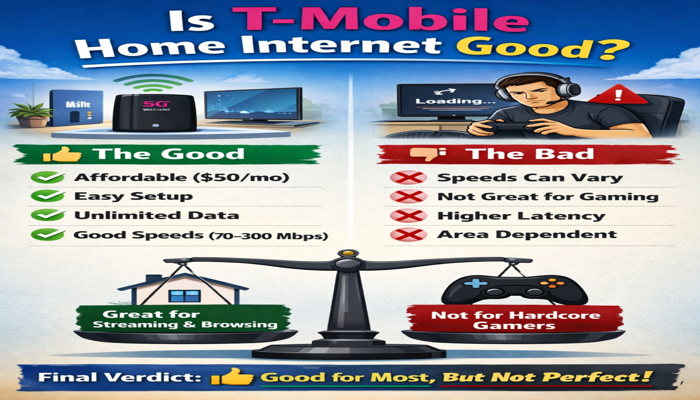
In recent years, home internet has evolved beyond traditional cable and fiber connections. One of the biggest disruptors in this space is T-Mobile Home Internet, which uses 4G LTE and 5G wireless networks to deliver broadband service without cables. But the big question remains: Is it actually good?
This detailed guide will explore performance, pricing, pros and cons, and whether it’s the right choice for your home.
What Is T-Mobile Home Internet?
T-Mobile Home Internet is a fixed wireless broadband service. Instead of using underground cables or fiber optics, it connects your home to nearby cellular towers using 5G or 4G LTE signals.
You receive a gateway device (router + modem combo) that converts the wireless signal into Wi-Fi for your home.
Key Features
- Simple Pricing
One of the biggest advantages is its transparent pricing model:
- Flat monthly fee (no hidden charges)
- No contracts
- No data caps
- Taxes and fees often included
This makes it much simpler compared to traditional ISPs that bundle fees.
- Easy Setup
Setting up T-Mobile Home Internet is extremely easy:
- Plug in the gateway device
- Download the mobile app
- Follow setup instructions
No technician visit is required, making it ideal for renters or quick installations.
- Unlimited Data
Unlike many providers, there are no hard data caps. This is great for:
- Streaming
- Remote work
- Gaming (to some extent)
However, speeds may slow during network congestion.
Performance and Speed
Typical Speeds
Speeds depend heavily on your location and signal strength:
- 5G Areas: 100 Mbps to 300+ Mbps
- 4G LTE Areas: 25 Mbps to 100 Mbps
While not as fast as fiber, it’s more than enough for:
- HD/4K streaming
- Video calls
- General browsing
Latency (Ping)
Latency is slightly higher than fiber or cable:
- 20–40 ms (good)
- Can increase during peak hours
This is acceptable for most users but may affect competitive gamers.
Reliability
Reliability depends on:
- Distance from towers
- Network congestion
- Weather conditions (rarely)
In urban areas, performance is generally stable. In rural areas, it can vary.
Pros and Cons
✅ Pros
- Affordable flat pricing
- No contracts or hidden fees
- Unlimited data
- Easy installation
- Portable (can move within coverage area)
❌ Cons
- Speeds vary by location
- Slower than fiber
- Performance drops during congestion
- Limited availability in some areas
Who Should Use It?
Best For:
- Renters or temporary residents
- People without fiber access
- Budget-conscious households
- Light to moderate internet users
Not Ideal For:
- Hardcore gamers
- Large households with heavy simultaneous usage
- Users needing ultra-low latency
Comparison with Other Internet Types
vs Cable Internet
- Cable: More stable and faster
- T-Mobile: Cheaper and simpler
vs Fiber Internet
- Fiber: Fastest and most reliable
- T-Mobile: More accessible and affordable
vs DSL
- DSL: Slower and outdated
- T-Mobile: Much faster and modern
Real User Experience
Most users report:
- Easy setup experience
- Good streaming performance
- Occasional speed fluctuations
Customer satisfaction is generally high, especially among users switching from slower DSL connections.
Pricing Overview (2026)
Typical plans from T-Mobile:
- Around $50/month (standard)
- Discounts available for mobile customers
No:
- Installation fees
- Equipment rental charges (included)
Is It Good for Work From Home?
Yes, for most remote work needs:
- Zoom calls: ✔
- Email & browsing: ✔
- Cloud work: ✔
However, if your job requires:
- Large file uploads
- Real-time collaboration tools
Fiber may still be better.
Is It Good for Streaming?
Absolutely. You can:
- Stream Netflix, YouTube, Prime Video
- Watch in HD and 4K
Buffering is rare unless network congestion is high.
Is It Good for Gaming?
It depends:
- Casual gaming: ✔
- Online multiplayer: ✔ (mostly)
- Competitive esports: ❌ (latency may be an issue)
Coverage Availability
T-Mobile is rapidly expanding its 5G network, but availability still depends on:
- Your city
- Tower proximity
- Signal strength
Always check availability before deciding.
Final Verdict
Yes, T-Mobile Home Internet is a good option—especially for affordability and simplicity.
It may not replace fiber for power users, but for everyday households, it delivers solid performance without the headaches of traditional ISPs.
Frequently Asked Questions (FAQ)
- Is T-Mobile Home Internet really unlimited?
Yes, there are no data caps, but speeds may slow during congestion.
- Can I use it for gaming?
Yes, but it’s best for casual gaming. Competitive players may experience latency issues.
- Does weather affect performance?
Generally no, but extreme weather can slightly impact signal strength.
- Is installation difficult?
No, it’s a plug-and-play setup that takes about 10–15 minutes.
- Can I move it to another house?
Yes, but only within areas covered by T-Mobile.
- How does it compare to fiber internet?
Fiber is faster and more reliable, but T-Mobile is cheaper and easier to set up.
- Are there hidden fees?
No, pricing is straightforward with taxes often included.
- What speeds can I expect?
Anywhere from 25 Mbps to 300+ Mbps, depending on your location.
- Is it good for large families?
It can work, but heavy usage may lead to slower speeds during peak times.
- Do I need a phone plan with T-Mobile?
No, but existing customers often get discounts.