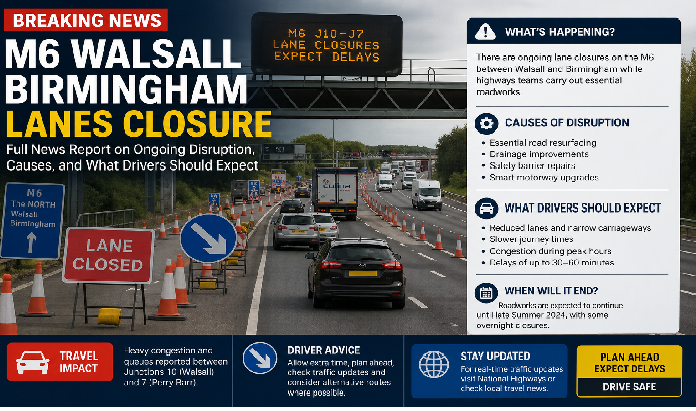
M6 walsall birmingham lanes closure are continuing to face significant disruption as a series of lane closures, overnight shutdowns, and emergency incidents impact one of the busiest motorway stretches in the United Kingdom. For thousands of daily commuters, logistics operators, and long-distance travellers, this key route through the West Midlands has become increasingly unpredictable in recent weeks.
The situation, driven by a combination of planned infrastructure works and unexpected accidents, has led to extended journey times, traffic congestion stretching for miles, and growing frustration among road users. Authorities maintain that the closures are necessary for long-term improvements, but for now, drivers are being urged to stay alert, plan ahead, and allow extra time for travel.
A Vital Transport Corridor Under Pressure
The M6 walsall birmingham lanes closure motorway plays a crucial role in the UK’s transport network, linking major cities across England and acting as a backbone for freight and passenger movement. The section between Walsall and Birmingham covering Junctions 4 through 10 is particularly important due to its proximity to key industrial areas, business hubs, and dense residential zones.
This stretch also connects to major interchanges, including the complex network near Birmingham often referred to as Spaghetti Junction. Because of its strategic importance, even minor disruptions in this area can quickly escalate into widespread congestion affecting surrounding roads and regions.
Traffic volumes on this part of the motorway are consistently high throughout the day, with peak hours seeing intense pressure from commuters heading into Birmingham city centre and beyond. As a result, any lane closures planned or unplanned tend to have an immediate and noticeable impact.
Why Are Lanes Being Closed on the M6?
The current wave of lane closures is largely due to essential maintenance and upgrade projects being carried out to improve the safety, durability, and efficiency of the motorway.
Infrastructure Maintenance and Repairs
One of the primary reasons for the closures is routine maintenance work. Over time, heavy traffic especially from large goods vehicles causes wear and tear on the road surface and supporting structures. To address this, authorities have scheduled resurfacing works, bridge repairs, and reinforcement of key sections.
Areas near Junctions 5 and 6 have been particularly affected, where ongoing work on viaducts and bridge joints has required lane restrictions and, in some cases, full overnight closures.
Smart Motorway Enhancements
The M6 walsall birmingham lanes closure in this region is part of the UK’s smart motorway network, which uses technology to manage traffic flow more efficiently. Upgrades to this system include installing advanced monitoring equipment, improving signage, and enhancing variable speed limit controls.
While these improvements aim to reduce congestion in the long run, they require temporary lane closures during installation and testing phases.
Emergency Incidents and Accidents
In addition to planned works, several recent incidents have contributed to the disruption. Accidents involving multiple vehicles, particularly heavy goods vehicles, have led to sudden lane closures and lengthy delays.
In some cases, spillages, vehicle damage, or the need for emergency repairs have forced authorities to shut down multiple lanes for extended periods. These unplanned events are often the most disruptive, as they occur without warning and can coincide with peak traffic times.
When Are the Closures Happening?
Most of the planned lane closures are scheduled during overnight hours, typically between 9:00 PM and 6:00 AM. This timing is intended to minimize disruption to daytime traffic, but the effects often carry over into the early morning, especially if work runs longer than expected or if traffic builds up before reopening.
During these periods, drivers may encounter:
- Reduced lanes, sometimes down to a single lane
- Full carriageway closures with diversion routes in place
- Temporary speed restrictions
- Narrow lanes and altered road layouts
Daytime closures are less common but may still occur in response to emergency situations or urgent repair needs.
Key Areas Affected
Certain sections of the M6 walsall birmingham lanes closure between Walsall and Birmingham have become known as hotspots for closures and delays:
Junction 10 (Walsall)
This area has long been a congestion point due to high traffic volumes and nearby development. Although recent improvement works have aimed to ease traffic flow, ongoing maintenance continues to cause periodic disruption.
This stretch sees heavy usage and is close to major connections into Birmingham. It is also an area where accidents are more likely due to the density of traffic and complex road layouts.
Ongoing structural work, including bridge and viaduct maintenance, has made this one of the most affected sections in recent months.
Diversions and Alternative Routes
When full closures are in place, drivers are typically redirected onto alternative routes, including major A-roads such as the A34 and A38. These roads provide connections between Walsall and Birmingham but can quickly become congested when large volumes of motorway traffic are diverted.
Another option for some motorists is the M6 walsall birmingham lanes closure Toll, which runs parallel to part of the main motorway and offers a less congested route. However, the use of this road involves a toll fee, which may not be suitable for all drivers.
Local roads have also seen increased traffic as drivers attempt to find shortcuts or avoid known congestion points. This has led to additional pressure on residential areas and smaller routes not designed for heavy traffic.
Impact on Daily Commuters
For regular commuters, the ongoing lane closures have introduced a new level of uncertainty into daily travel. Journey times have become less predictable, and many drivers are having to adjust their routines to avoid peak congestion.
Some of the most common challenges reported by commuters include:
- Longer travel times, sometimes increasing by 30 to 60 minutes
- Stop-start traffic leading to increased fuel consumption
- Stress and fatigue caused by unpredictable delays
- Difficulty planning arrival times for work or appointments
Public transport has become an alternative for some, but for many, especially those travelling between areas not well connected by rail or bus, driving remains the only practical option.
Impact on Businesses and Logistics
The M6 walsall birmingham lanes closure is a key route for the movement of goods across the UK, and disruptions along this corridor can have significant consequences for businesses.
Logistics companies, delivery services, and manufacturers rely on timely transportation, and delays on the motorway can lead to missed deadlines, increased operational costs, and reduced efficiency.
For businesses operating on tight schedules, even minor delays can disrupt supply chains. The cumulative effect of repeated closures and congestion can also impact customer satisfaction and overall productivity.
Advice for Drivers
Authorities are encouraging drivers to take proactive steps to minimise the impact of the closures
- Check traffic updates before travelling: Use navigation apps or official traffic reports to stay informed about current conditions
- Allow extra time for your journey: Especially during peak hours or when travelling through known hotspots
- Consider alternative routes: Even if slightly longer, they may offer a more reliable travel time
- Follow road signs and instructions: Temporary layouts can change quickly, so staying alert is essential
- Be cautious during night driving: Reduced visibility and changing road conditions require extra attention
Long-Term Benefits vs Short-Term Disruption
While the current situation is causing inconvenience, transport authorities stress that the work being carried out is essential for the long-term improvement of the motorway.
Upgraded road surfaces, stronger infrastructure, and smarter traffic management systems are expected to reduce congestion, improve safety, and support growing traffic demand in the future.
However, achieving these benefits requires temporary disruption, and drivers are being asked to remain patient as the work progresses.
Looking Ahead
Lane closures on the M6 walsall birmingham lanes closure between Walsall and Birmingham are expected to continue in the coming months as projects move through different phases. While some sections may reopen fully, others may undergo new rounds of maintenance or upgrades.
The combination of high traffic volumes and ongoing work means that this stretch of motorway is likely to remain a challenging route for the foreseeable future.
For now, staying informed, planning ahead, and adapting to changing conditions remain the best strategies for navigating the disruption.
Conclusion
The ongoing lane closures on the M6 walsall birmingham lanes closure highlight the challenges of maintaining a critical piece of national infrastructure while keeping traffic moving. As essential works continue and unexpected incidents arise, drivers must remain prepared for delays and disruptions.
Although frustrating, these efforts are aimed at ensuring that the motorway remains safe, reliable, and capable of handling future demand. Until then, patience and planning will be key for anyone travelling along this vital route.
Frequently Asked Questions (FAQs)
- Why are there lane closures on the M6 between Walsall and Birmingham?
Lane closures are mainly due to essential maintenance work such as resurfacing, bridge repairs, and smart motorway upgrades. In some cases, unexpected incidents like accidents or vehicle breakdowns also lead to temporary lane restrictions.
-
What time do most M6 lane closures take place?
Most planned closures are carried out overnight, typically between 9:00 PM and 6:00 AM to minimise disruption during peak traffic hours. However, delays can sometimes extend into the early morning.
-
Which sections of the M6 are most affected?
The most impacted areas are usually between Junctions 4 and 10, especially near Junction 6 (Birmingham) and Junction 10 (Walsall), where traffic volume is high and major works are ongoing.
-
How long will the lane closures continue?
There is no single end date, as works are carried out in phases. Some closures may last for a few days, while larger infrastructure projects can continue for several weeks or months.
-
Are there alternative routes to avoid M6 closures?
Yes, drivers can use alternative routes such as the A34, A38, or opt for the M6 Toll road to bypass congestion. However, these routes can also become busy during peak times.
-
How can I check live updates on M6 traffic and closures?
You can stay updated by using navigation apps, live traffic websites, or official highway updates before starting your journey. This helps you avoid delays and choose the best route.