
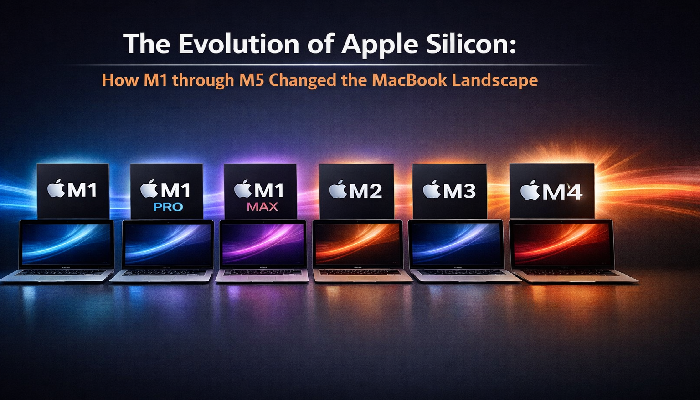
The shift from Intel processors to Apple’s own silicon marked one of the most significant turning points in the history of the MacBook. What began as a bold architectural gamble has, over several generations, fundamentally reshaped how Apple laptops perform, how long they last on a charge, and how they are priced. To understand why modern models command a premium in 2025, it helps to look at how Apple Silicon evolved from its earliest versions into the mature platform users rely on today.
When Apple announced it would abandon Intel, scepticism was widespread. Many users wondered whether performance would suffer, whether software compatibility would lag behind, and whether professional workloads could realistically run on a new processor architecture. Those doubts were understandable, given how long Intel chips had defined Mac laptops. Yet within a surprisingly short time, MacBooks running Apple Silicon began to challenge long-held assumptions about what thin and light laptops could deliver.
The first generation of Apple Silicon, the M1, arrived as a quiet revolution rather than a flashy overhaul. Instead of chasing raw clock speeds, Apple focused on efficiency, integrating CPU, GPU, memory, and neural processing into a single system on a chip. The result was a MacBook that felt instantly responsive, ran cooler than its Intel predecessors, and delivered battery life that seemed almost unrealistic by laptop standards. For everyday users, the improvement was obvious within minutes of use.
As the M-series developed, Apple refined this foundation rather than reinventing it. The M2 focused on incremental gains, improving graphics performance and memory bandwidth while keeping power consumption tightly controlled. This approach reinforced Apple’s strategy: rather than dramatic leaps each year, it aimed for predictable, sustainable improvements that compounded over time. For consumers, this meant that even base-level models began outperforming older high-end Intel machines.
The introduction of the M3 marked a more visible step forward, particularly for professional users. Built on a more advanced manufacturing process, it delivered notable gains in GPU performance and supported more demanding creative workloads. Tasks such as video rendering, 3D modelling, and software development benefited from faster sustained performance without the thermal throttling that often plagued Intel laptops. Importantly, these gains came without sacrificing the quiet operation that had become a hallmark of Apple Silicon machines.
By the time the M4 generation arrived, Apple Silicon was no longer new or experimental. It was the default expectation. The improvements here focused on real-world workflows: faster machine-learning tasks, smoother multitasking, and improved external display support. For many users, the distinction between “entry-level” and “pro” MacBooks became less about whether the device was capable, and more about how much headroom they wanted for future demands.
In 2025, the latest Apple Silicon chips represent a mature ecosystem rather than a single product advantage. Software optimisation plays a crucial role in this. macOS and many third-party applications are now designed specifically for Apple Silicon, allowing them to take full advantage of unified memory and specialised processing cores. This tight integration between hardware and software is something Intel-based Macs could never fully achieve, and it explains why performance gains often feel larger than benchmark numbers alone suggest.
Another key factor in the evolution of Apple Silicon is longevity. Apple’s chips are designed with future operating systems and features in mind, extending the usable life of each device. A MacBook bought today is more likely to receive major software updates and maintain strong performance several years down the line. This long-term value helps justify the higher upfront cost of newer models, especially when compared to older Intel machines that are increasingly limited by thermal and architectural constraints.
The price gap between Intel and Apple Silicon MacBooks in 2025 is therefore not arbitrary. It reflects years of investment in custom chip design, manufacturing partnerships, and software optimisation. While refurbished Intel models still have a place for specific legacy needs, they represent a previous era of Apple’s laptop strategy. Apple Silicon machines, by contrast, are built for the workloads and expectations of modern computing.
Looking back, the journey from M1 to the current generation shows a clear pattern. Apple did not simply replace Intel with something equivalent; it redefined what a MacBook could be. Faster performance, exceptional efficiency, and long-term usability have become standard rather than premium features. That evolution explains not only the success of Apple Silicon, but also why its MacBooks now occupy a different position in the market than they did just a few years ago.